

Connection · Eating habits
Why connection matters when changing your eating habits
From Rat Park to recent studies of loneliness and eating, why building meaningful connection belongs alongside changes to your food and activity.

Adam James
22 October 2026 · 6 min read
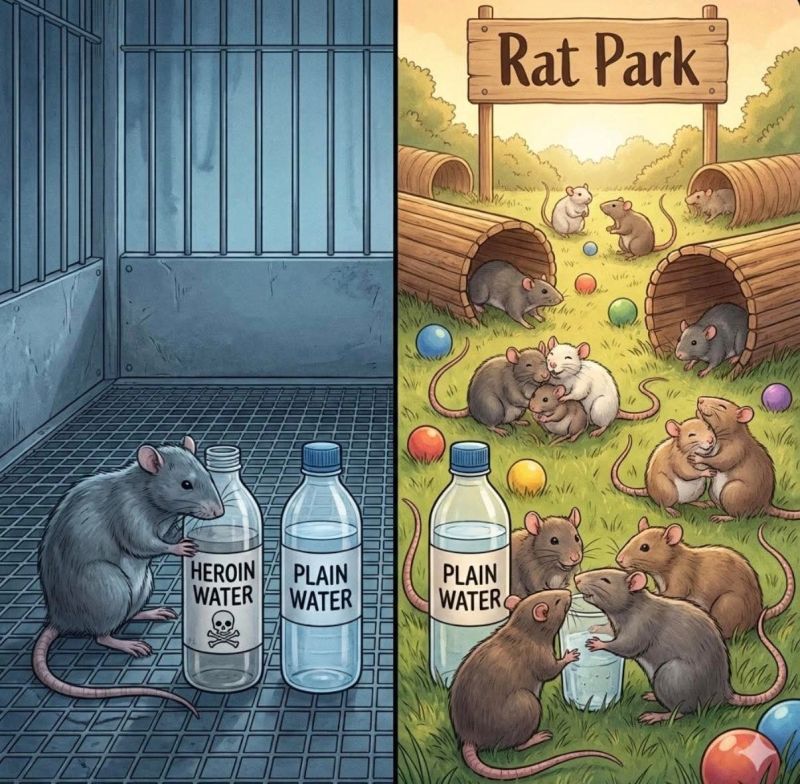
In the late 1970s, psychologist Dr Bruce Alexander and his colleagues at Simon Fraser University investigated whether a rat’s surroundings affected its drug consumption. Some rats lived alone in standard laboratory cages. Others lived together in a larger, enriched environment known as Rat Park.
In one study, the rats could choose between plain water and a sweetened morphine solution. The isolated rats drank significantly more morphine than the colony rats. Changing the living conditions appeared to change the appeal of the drug. [1]
The rats in Rat Park had other rats to socialise and mate with, room to explore, and things to climb on and play with. [2] They lived in a richer, more stimulating environment, and they consumed less morphine. Rat Park gives us a useful reason to consider the environment surrounding a habit.
What human research tells us about connection and eating
Human research gives us a closer look at how connection relates to eating. Researchers often measure loneliness: the gap between the connection someone wants and the connection they feel they have. You can spend time around people and still feel disconnected. [3]
In a 2024 study of 93 participants, researchers combined questionnaires about loneliness and eating with body composition measurements and brain scans. People who felt more isolated reported stronger food cravings, more uncontrolled eating and more symptoms on a food addiction questionnaire. They also had higher body fat and poorer diet quality on average. [3]
During the scans, participants viewed pictures of food. Greater loneliness was associated with stronger responses in brain regions involved in attention and processing internal states, particularly for sweet foods, and reduced activity in regions involved in executive control. This suggests a possible link between feeling disconnected and how compelling food seems. The study captured associations at one point in time; it did not show that loneliness caused these differences or test whether building friendships reversed them. [3]
A 2025 Lebanese study examined 384 young adults aged 18 to 25, including 140 men. Participants completed questionnaires about loneliness and their eating habits, including restriction and concerns about eating, weight and body shape. Greater loneliness was associated with more disordered eating overall. Among the men, the significant links included restrictive eating, concerns about weight and the overall eating difficulties score. [4]
That finding broadens the picture. Struggling with food can involve eating too much, but it can also involve restrictive habits or distress about weight. The Lebanese research supports paying attention to loneliness when someone has a difficult relationship with food; it does not establish that lonely men necessarily overeat or develop obesity. [4]
A Norwegian study published in 2022 followed 2,933 young people at four points over 13 years, from adolescence into adulthood. Among boys, increases in loneliness in early to middle adolescence predicted increases in disordered eating and dieting at the next assessment, two years later. The researchers examined changes within individuals while accounting for stable differences between people. The male finding was mainly driven by dieting symptoms. [5]
Following people over time adds something a single survey cannot: evidence about which changes came first. The Norwegian findings suggest that loneliness can precede eating difficulties, rather than simply appear alongside them. The pattern also varied by age and type of eating problem. It remains observational evidence, so it cannot establish that loneliness caused the later difficulties. [5]
Taken together, these studies give us a reason to include social and emotional life in the conversation about eating. They examine different behaviours, so food addiction, restrictive eating and obesity should not be treated as interchangeable. For Reclaim, the practical implication is to consider whether loneliness or distress is part of your own eating pattern, and to build meaningful support alongside changes to your food and activity. Connection is a potential source of support, not a proven stand-alone treatment for obesity. [3–5]
What this means for your Reclaim journey
If eating sometimes helps you manage loneliness or distress, it makes sense to work on that unmet need alongside your eating habits. A meal plan cannot provide companionship. Building regular, meaningful contact with other people may be a valuable part of your approach.
Your circumstances may be different. Obesity has many contributors, including genetics, sleep, medication and the food environment. [6] Use this lesson to explore what applies to you, without assuming that your weight reveals something about the quality of your relationships.
Build strong connections inside and beyond Fireside
Community is central to how Fireside Health is designed to support change. In Reclaim, you have the opportunity to build strong connections with other men who are committed to valuing their health. You can share what is working, speak honestly when you struggle, and encourage each other to keep going.
Our aim is for those relationships to give you practical support and a sense of belonging. Being accountable to other men also means showing up for them: listening, celebrating their progress and offering encouragement when they need it.
Membership alone is not enough. To flourish, you also need to give attention to the relationships that make up your everyday life: your family, friends and colleagues. Fireside should support a fuller life beyond the group.
That might mean making time with your partner without distractions, reconnecting with a friend, rediscovering an old hobby or trying a new one with friends or other men, being more present with your children, or treating a colleague with greater patience. Healthy connection includes listening, respect and appropriate boundaries. Start with the relationships and circumstances that apply to you.
Reclaiming your health includes building a daily life that supports the changes you want to make. Connection is one part of that work, alongside nutrition, movement and appropriate professional care.
Sources and study details
- 1. Hadaway PF, et al. The effect of housing and gender on preference for morphine-sucrose solutions in rats. Psychopharmacology. 1979;66:87–91.
https://doi.org/10.1007/BF00431995 - 2. Alexander BK. Addiction: The View from Rat Park. 2010. Alexander’s account describes the social setting, climbing platforms, hiding places and running wheels.
https://www.brucekalexander.com/articles-speeches/177-addiction-the-view-from-rat-park-2 - 3. Zhang X, et al. Social Isolation, Brain Food Cue Processing, Eating Behaviors, and Mental Health Symptoms. JAMA Network Open. 2024;7(4):e244855. Study population: 93 women; observational findings should not be assumed to apply equally to other populations.
https://doi.org/10.1001/jamanetworkopen.2024.4855 - 4. Samaha N, Assaf R, Zalaket N. The Relationship between Loneliness and Disordered Eating Behaviors: The Impact of Gender and Relationship Status-A Cross-sectional Study. The Open Psychology Journal. 2025. Study population: 384 Lebanese adults aged 18–25, including 140 men.
https://doi.org/10.2174/0118743501377094250511164619 - 5. Cortés-García L, Rodríguez-Cano R, von Soest T. Prospective associations between loneliness and disordered eating from early adolescence to adulthood. International Journal of Eating Disorders. 2022;55(12):1678–1689. Mixed cohort of 2,933 participants followed from adolescence into adulthood; the male finding described above concerned adolescence and was mainly driven by dieting.
https://doi.org/10.1002/eat.23793 - 6. National Institute of Diabetes and Digestive and Kidney Diseases. Factors Affecting Weight and Health.
https://www.niddk.nih.gov/health-information/weight-management/adult-overweight-obesity/factors-affecting-weight-health
Fireside Health — Better Men. Better Health. Together.